
You are not broken. You are carrying something.
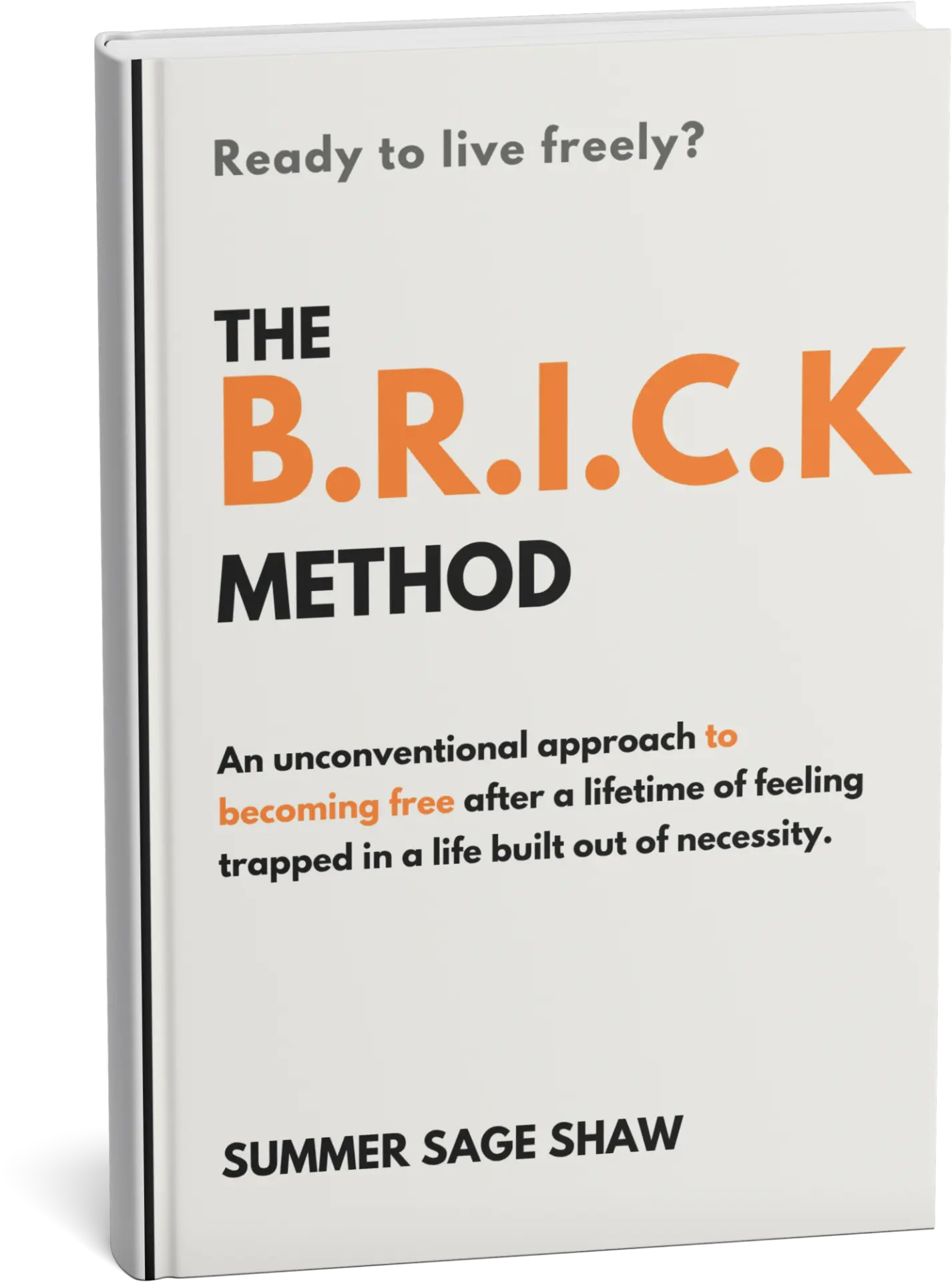
The B.R.I.C.K. Method is an unconventional approach to becoming free after a lifetime of feeling trapped in a life built out of necessity. Find where you actually are, choose one thing you're carrying, and put down what was never yours.
44 pages · workbook included · by Summer Sage Shaw
You are not the brick. You are the builder.
I know why you can't find it.
- You are looking for something that feels bad — and most of what is crushing you feels like devotion.
- You judge your whole life by its worst quarter, then call yourself a four out of ten.
- You keep dropping the same brick, and it keeps coming back with the same sentence attached.
- You got stable, and then quietly started arranging your entire life around not losing it.
- You are early, not failing — and your body is running on old information.
You don't put a story down. You replace it with one you chose.
Two tools, one set of qualities, and one thing you do with all of it.
This is a method, not a manifesto. You can learn the whole thing in an afternoon and use it for the rest of your life.
The wheel
Your life has four parts, and each one is at its own stage. Most people judge the whole thing by the worst part.
The brick
One thing you're carrying, inside one part. Clean it, repair it, drop it, or keep it.
The glue
Seven qualities and love. The thing that makes a new choice stick.
The story
How the qualities become visible, and how anyone else gets to cross.
Not a ladder.
A cycle.
Determine the brick. Let the space open. Locate yourself in it. Build the path. Then walk through the door — and do it all again to build the next brick to step on. The wheel sits in the middle because it holds the whole thing together: every time you get stuck, you go back to it.
The Brick
Decide what's in and what's out.
The Space
What's left is yours. Don't be afraid of it.
The Wheel
Look closely. Locate yourself. Every time you get stuck, you come back here — the wheel tells you where you actually are, so you can see what's left, determine the next brick and find the next door.
The Path
Choose the next step. Build something to walk on.
The Door
Walk through. Then start again on the other side.
Brick → Space → Wheel → Path → Door → and again, one brick higher
S.E.L.F. — where am I?
Your life is not one thing, so it can't be one score. Four parts, and they are never in the same condition at the same time.
- 1. Survival
- 2. Stable
- 3. Emerging
- 4. Building
Read it from the centre out. Four pillars around, four stages deep — you are never on one number, you are on four.
Not how many people you know. Who is actually here, and whether you would call them.
Not whether you love the work. Whether the money works. Keep those separate.
Health, body, energy, and the texture of an ordinary Tuesday. Not your goals — your Tuesday.
Purpose, dreams, identity, creativity — and whether you still believe any of it is available to you.
Every pillar sits at one of four stages.
Intention — you need a why just to get up.
Attention — power goes where you keep looking.
Direction — some of it known, most of it not.
Level — doing publicly what you learned privately.
You're not in one stage. You're in four — and you start with the loudest, not the lowest.
Is this a brick? Five questions.
A brick is a pattern. It runs on its own, it was installed a long time ago, and it keeps running until something interrupts it. The method is the interruption — small enough to run in a meeting, mid-sentence, in ninety seconds.
Breathe
You cannot choose while moving automatically. The everyday version is one sentence: let me think about that.
Recognize
“I notice I'm carrying it” — not “I am it.” One is a pattern. The other is a personality, and you cannot put down a personality.
Investigate
Whose sentence is this? When did I learn it? What did it protect me from? What does it cost now? Is this brick mine?
Choose
Clean, repair, drop, or keep — and notice who is choosing.
Keep
Do I still want to carry this? Own the choice — and keep the space it opened, because if you don't defend it, something moves in.
Then you do one of four things.
Clean it
It's yours, but it's covered in things that aren't. Guilt, resentment, somebody else's expectations.
Repair it
The responsibility is real. The way you're carrying it is cracked.
Drop it
It was never yours — or it belongs to a specific adult person. You're not abandoning a responsibility, you're correcting an address.
Keep it
You would choose it again today. Keeping something on purpose is a completely different life from carrying it by default.
Most people try to drop a brick that only needed cleaning.
When something won't hold, one of the eight is missing.
Layers of the glue — every quality holding every other one
Each one contains the other seven. Courage without curiosity is recklessness. Care without consistency is a nice intention. Competence without compassion is cold. When all eight are present in one thing, that is mastery.
And love isn't a feeling here — it's a verb. The thing you do, the way you behave, the steps you take. Love as a feeling says yes; your calendar is the more honest witness.
A bridge nobody crosses is a wall lying down.
You build a bridge, brick by brick — survival on one side, freedom on the other. Storytelling is the crossing, and you tell it while you're still on it, not from the far side once it's finished and safe and no use to anyone. A story told honestly becomes universal, not because it's dramatic, because it's specific.
A bridge nobody crosses is a wall lying down
What's inside the book.
- The S.E.L.F. wheel — four pillars, four stages, and how to read your own map.
- How the stages actually move, including the two places almost everyone gets stuck.
- The story inside the brick, and the sentence underneath the thing you carry.
- Clean, repair, drop, keep — plus the three rules that stop you giving the answer that sounds good.
- The joy check: heavy, neutral, joyful — and why heavy is the doorway.
- The eight qualities of the glue, and the one-question diagnostic when nothing holds.
- The five questions underneath every brick: why, what, when, who, how.
- The whole method on one page, plus a four-sheet workbook you can fill in tonight.
The B.R.I.C.K. Method — yours, free.
The wheel, the brick, the glue, the story, and a four-sheet workbook. Drop your email and the download starts straight away.
Summer Sage Shaw

Writer, artist, strategist and dialogue facilitator — founder of Beginner Mind and SSS Collective. I build systems and brands for businesses, and I write books, poems and songs. For me it is the same river running through different channels: the search for connection, meaning and expression.
The B.R.I.C.K. Method came out of learning that strength meant carrying everything, and noticing far too late that most of what I carried I had never chosen. The S.E.L.F. wheel is what I use to find out where I am before I decide anything.
“We take practice seriously, but we don't take ourselves too seriously.”
Frequently asked questions.
Is this therapy?
No. Nothing here is a diagnosis — it's a way of seeing. If something in your life needs a doctor, a therapist or a lawyer, this is not that, and using it as though it were is its own kind of brick.
How long does it take to learn?
An afternoon. Two tools, one set of qualities, and one thing you do with all of it. Then you use it for the rest of your life.
What if nothing comes when I answer the questions?
Then nothing comes. Forced answers are made of what you think you should say, and you cannot put down something you invented. “I don't want to answer this” is the most honest answer there is.
Where do I start if everything feels heavy?
With the loudest quarter, not the lowest. And with one brick — not the pillar, not the life. The whole method fails the moment you try to fix everything at once.
Do I have to share my story publicly?
You choose which parts, in which moments. Share from a scar, not a wound. But a quality is invisible until you use it — courage doesn't exist until it's spoken.
What does it cost?
The book is free. Give us an email and it's yours. If you want to work through it with people, that happens at Open Mat and in one-on-one sessions.