
Give me 21 days and you'll know what you're building.
The First Brick is a 21-day challenge for teachers and practitioners who have tried a lot of things and still can't say which one is theirs. You'll leave with a one-page plan, your marked wheel, one brick put down — and one thing actually made.
15–30 minutes a day · two live calls · private community · $199 founding cohort
Everyone else builds the business, then lives around it.
We design the life first, then build the income that fits it. Which is why this challenge starts three steps earlier than every other one: where are you, what are you carrying, and what do you actually have.
You don't need another tactic. You need to know which box you're standing in.
And you still can't say what you're building.
- The course you bought and didn't finish.
- The account you started and abandoned in week three.
- The Notion page called IDEAS with forty-seven entries in it.
- Everyone tells you you're talented. You've finished almost nothing.
- You want out — and you have no idea what you'd do instead.
Not because you lack ideas. Because nobody ever helped you locate yourself first.
Three weeks, three acts.
One short video, one prompt, one small action per day. Nothing new is introduced after week one — twenty-one days of the same method applied to different material.
- 1. Survival
- 2. Stable
- 3. Emerging
- 4. Building
It starts with a blank wheel.
Four parts of your life, four stages deep. Day one you draw it, day seven you show it — with the loudest quarter circled. That marked wheel is what everything else in the 21 days is built on.
Locate
Where you actually are, in four parts. Ends with a marked wheel and the loudest quarter circled.
- 01The map in ten minutesDraw the blank wheel. That's the whole action.
- 02S — SupportRead the four sentences. Tick the one that stings.
- 03E — EarningsDoes the money work — not on the best month.
- 04L — LifeNot your goals. Your Tuesday.
- 05F — FaithWhat have you stopped believing is available?
- 06You're in four stages at onceCircle the loudest, not the lowest.
- 07Show your wheelFirst public act. Low stakes, high commitment.
Clear
The reason you know what to do and don't do it. Ends with one brick chosen and one protection in place.
- 08Not all bricks look heavySome feel like love, loyalty, strength. Still weight.
- 09The three rulesDon't force it. No surface answers. Ask why five times.
- 10The joy checkHeavy, neutral, joyful. Today's heavy is the doorway.
- 11Is this a brick?Run the five questions on one real thing.
- 12Whose sentence is it?The story inside the brick, and where it came from.
- 13Clean, repair, drop or keepMake the actual choice. Write the four lines.
- 14The glueWhich of the eight is missing? One protection for the week.
Build
What to build, and the smallest real version of it. Ends with the one-page plan and one thing made.
- 15Known, gap, fogThree zones on your loudest quarter. Three different problems.
- 16What do people come to you for?The evidence you've ignored because it's ordinary to you.
- 17Pick one craftSixteen boxes, sixteen crafts. Nobody is expert in all of them.
- 18Build your own howSix questions. What comes out is your method.
- 19Make the smallest versionToday. Badly. It only has to exist.
- 20Tell itThe story around the thing, in front of real people.
- 21Your one pageWhat I'm building, why it's mine, and the next brick.
Days 7, 14 and 21 are shared in the community. Three shares over three weeks — enough for accountability, without turning the whole thing into performance.
Twenty-one days, one person.
Mara, 34. Designer at an agency for nine years. Ceramics at weekends, half a novel, a newsletter that lasted six weeks, a photography course, forty-seven ideas in a Notion page. She isn't in crisis — which is exactly why she could never explain why she felt stuck.
Support 2, Earnings 2, Life 2, Faith 3. Nothing at survival — and her loudest quarter was her highest one. Emerging freedom had been feeling exactly like survival for two years.
“Keeping my options open” → if I pick one thing and turn out mediocre, then I was never talented. Unproven potential is safer than proven mediocrity. She'd been protecting a reputation from when she was fourteen.
Every joyful thing was made for one specific person. Every heavy thing was made for an audience. Four years of forcing the heavy column, because that's what building is supposed to look like.
She asked five people what they actually come to her for. Three said the same thing. It wasn't the ceramics or the novel — she gives small makers a coherent identity, and had done it free eleven times.
Identity design for small makers. One page, one price, one message a week. One of the four makers she sent it to replied the same evening asking for a call.
She didn't find a new idea. She found the one she was already doing for free.
The stack.
The B.R.I.C.K. Method
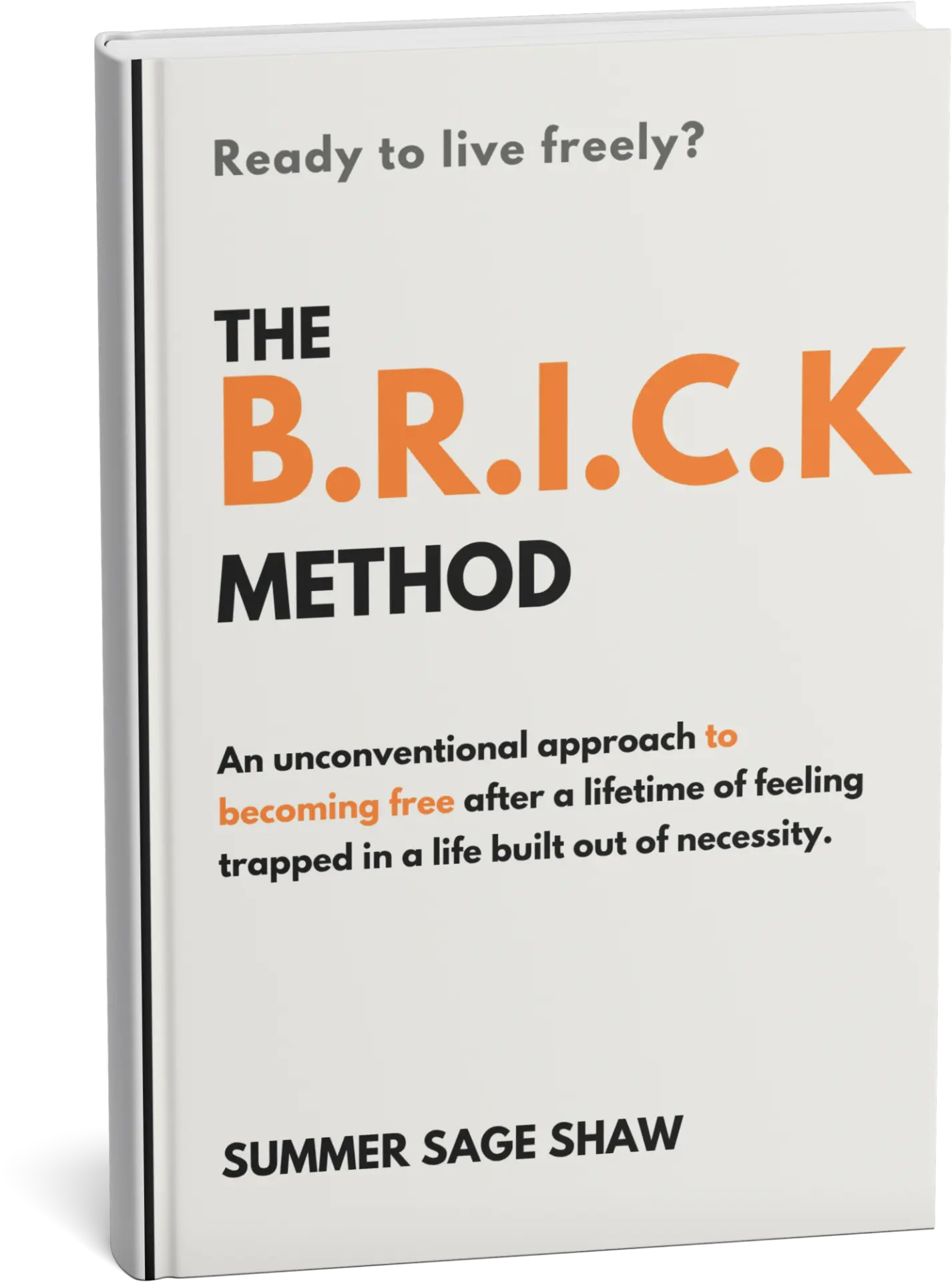
The 44-page book as your pre-read, so day one isn't the first time you meet the method.
The Locating Workbook
Five printable sheets — recognition grid, the four questions, blank wheel, blank brick.
21 daily videos
8–12 minutes each. One prompt, one small action. Fifteen to thirty minutes a day.
Two live calls
The map, run live on real wheels. Then the method, with a real brick worked in front of the room.
The community
One space, three prompts a week. Days 7, 14 and 21 are shared — accountability without performance.
The eight qualities diagnostic
One yes/no question per quality, so you can find the missing one without anyone in the room.
The story session
How to tell it while you're still on the bridge, not from the far side once it's safe.
Lifetime access
Re-run your own 21 days whenever the wheel turns. Which, given the method, it will.
Founding cohort
21 days, two live calls, the community, the book, the workbook, lifetime access.
Priced low because it's the first run.
Limited seats
Everything in Core, plus small-group calls where your wheel is read personally.
The natural next step after the challenge.
The first cohort price.
This is the first cohort. It's $199 because it's the first one — we're building the system together, in front of you. The next cohort pays more, because by then it'll be finished rather than in progress.
Starts November 30th. Ten people. When it's ten, it's closed.
Starts November 30th · ten people · when it's ten, it's closed.
 Claim a founding-cohort seat
Payment link sent when you're confirmed.

Summer Sage Shaw
Writer, artist, strategist and dialogue facilitator — founder of Beginner Mind. I wrote The B.R.I.C.K. Method after learning that strength meant carrying everything, and noticing far too late that most of what I carried I had never chosen.
For these 21 days I'm in the room with you: two live calls, a daily drop, and the wheel we mark together.
Read the free book first →Join the waitlist for the first run.
The founding cohort is small and priced low, because it's the first one. Tell us where you are and we'll be in touch with dates, the webinar invite and how to take a seat.
Start with week one, today.
The Locating Workbook — five printable sheets: the recognition grid, one question per box, how the stages move, your blank wheel and your blank brick. It's day one to day seven, on paper.
Do the twenty-one days, or get your money back.
If you do the twenty-one days and still don't have your page, I'll refund you. The conditions: watch the lessons, do the daily task, share it in the group. All twenty-one.
The conditions aren't there to protect me — they're there because doing them is the thing that works.
Got questions? Answers.
Why not just start with “what should I build”?
Because you'd pick the wrong thing and quit in week three, then blame yourself again. Week two clears what would otherwise make week three impossible. On day one Mara would have said ceramics — and she would have been wrong.
How much time does it take a day?
Fifteen to thirty minutes. One short video, one prompt, one small action. It's designed for people with jobs.
Do I have to post publicly every day?
No. Three shares over three weeks — days 7, 14 and 21 — inside the private community. Public daily posting turns the work into performance, which contradicts the method.
What do I actually walk away with?
A one-page What I'm Building plan, your marked SELF wheel, one brick put down, and one thing made and shown. Something you can hold up, not just a feeling.
What if I finish with two candidates instead of one?
That's a finished page too — as long as it carries a test and a date. Without those it's fog with better typography.
Is this therapy or coaching?
Neither. It's a method for locating yourself and building. If something in your life needs a doctor, therapist or lawyer, this isn't that.